Home / How it works
How PhysKit works
What the plugin contains, the five skills to know by name, and who does what inside a closed-loop research campaign.
What's inside
- Skills: written procedures for recurring research tasks, such as framing a problem, verifying a result, designing a simulation, or writing a report.
- A core prompt: the short set of rules for honest, verified, traceable work.
- Templates: ready-made folder structures and documents for projects and research campaigns.
- Code: the scripts that run campaigns, score results with a frozen metric, and label how each result was checked.
Five skills to know by name
frame-problem | start any physics problem here — before modeling, simulating, or deriving |
verify | check a result, number, or derivation before relying on it |
report | write it up — every number labeled by provenance, every citation verified |
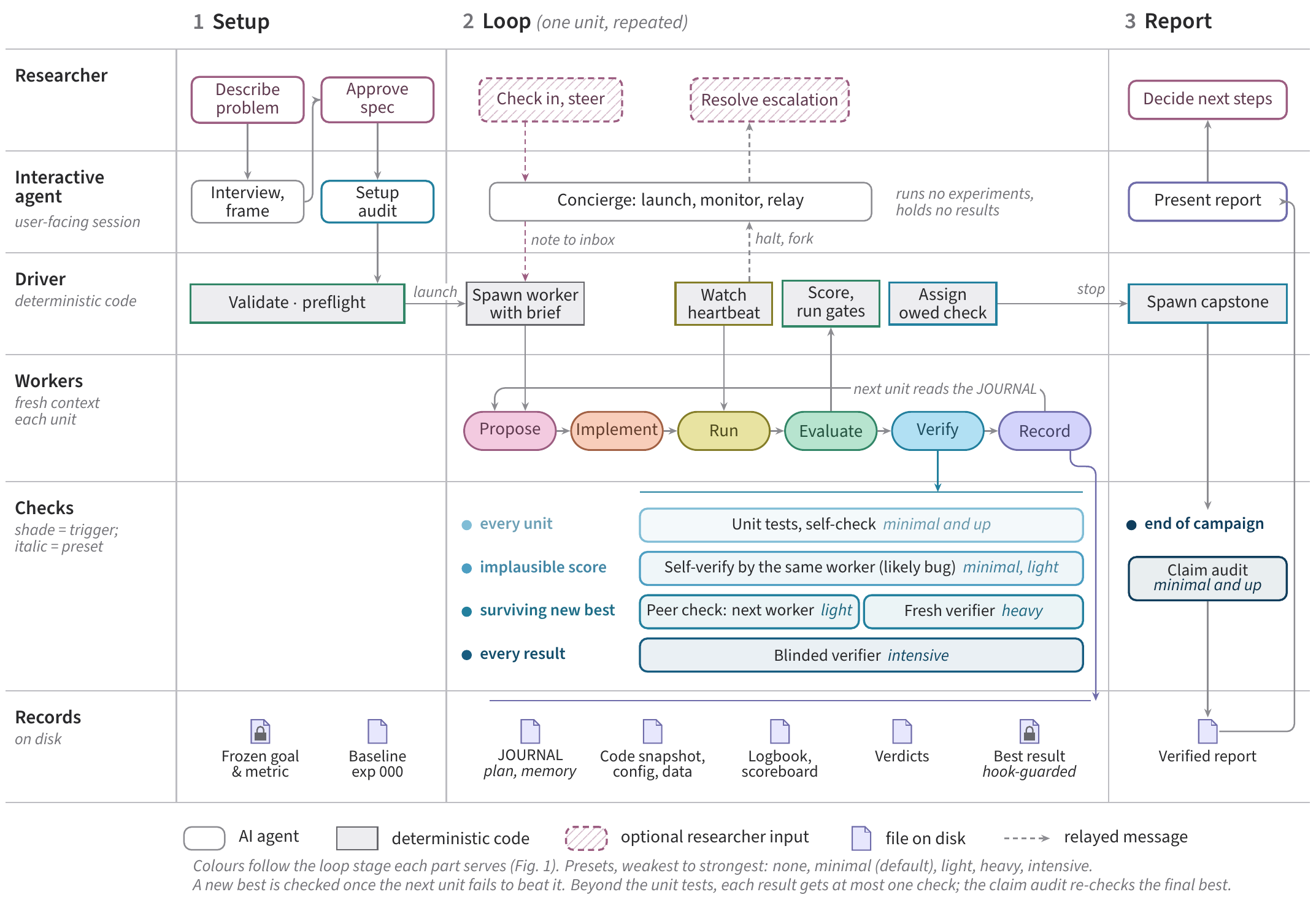
new-campaign | stand up a closed-loop research campaign |
campaign-status | health-check or checkpoint a running campaign |
Inside a campaign